Showing posts with label superman. Show all posts

Friday, 5 April 2019

Reflections: Growing Up With Music


A personal view about the music of John Williams and its role in my upbringing


This is a piece I wrote for the website thelegacyofjohnwilliams.com, curated by my brother Maurizio, who is doing  a remarkable job in "building a platform to celebrate and promote the cultural and aesthetic importance that the music of John Williams had (and it’s still having) on many people around the world".
I'm honored to having contributed the illustration for the header of the website, you can see here below.
Thanks to Maurizio for allowing me to me share my thoughts on his website.


As I am typing this, the sound of my son practicing scales on the piano resonates through the house.

I think back to my short-lived affair with the instrument.

I was about seven years old and I wanted to learn how to play piano from one of my older brothers, but he had just left to study in Rome. I was put under the tutelage of another teacher; whose lessons were tedious and devoid of the kind of fun I used to have around my brother. I quit after six months, a decision I still regret. But I wasn’t left without musical mentors.

Thinking of my older brother, a recent conversation we had springs to my mind about the different music teaching methods. He was telling me a funny anecdote involving an acquaintance of his, who wanted to educate his son outside of the western tonal system, to spare him from the conditioning imposed by our musical tradition, which puts certain intervallic relationships (like the tonic-dominant) above other possible modes. Ironically, this person’s efforts were made vain by the many nursery rhymes that the kid learned at school—nothing stick to our brains like simple, diatonic major melodies.

What’s the point of this story? Well not so much to discuss the pros and cons of equal temperament, but rather to point out how glad I am to be able to participate in the conversation. Because despite having given up on piano (or any other instrument for that matter) I’m not musically illiterate.

And for that I must thank John Williams.

Make no mistakes: I admit that the reason I gravitated towards Mr. Williams’ music were the movies he scored. Like many kids in the 1980s, I was utterly captivated by movies like Star Wars, Superman or E.T. They were perfectly executed pieces of fiction easy to fall in love with. Listening to those scores was a pathway to that sense of wonderment and excitement those movies provided.

But on repeated listening, the richness of these scores started to intrigue me. The dramatic drive of the pieces made the narrative clear, so I could tell at which point of the story I was listening to. The melodic writing made every moment memorable and singable. The rich instrumentation and length of the cues sustained my interest. So much that, as a teen ager, it took a long time to adjust my ears to the pop-music I was “supposed” to listen in the 1990s, to keep at pace with my schoolmates, who were into grunge, indie rock or Britpop.

But no matter how important John Williams music was to ignite my interest in music, you need teachers in flesh and blood to make the seed blossom.


Luckily, I had at least one: Umberto Bombardelli, a composer himself, who taught music at my middle school. He could have come right out of movies like Mr. Holland’s Opus or Goodbye, Mr. Chips—he even looked like Peter O’ Toole in that 1969 movie (with music adapted and conducted by John Williams, by the way).

At the time, music was a mandatory subject in Italy for students in middle school between the age of 11 and 14, but it was easily disregarded as an extra or a commodity, certainly not the subject that would make or break your graduation. However, Mr. Bombardelli taught passionately, with patience and humor, becoming soon known by his pupils as “the good teacher”.

He did a lot more than just make us play the recorder or put on Prokofiev’s Peter and the Wolf. He made us listen to various type of music (from Palestrina to Demetrio Stratos and Luciano Berio), teaching us about the different musical periods and styles. He even showed us movies and made us pay attention to the music (The Blues Brothers, Walt Disney’s Fantasia and also the Williams-scored The Cowboys). To this day, I owe him for laying the foundations of any musical knowledge I may have.

As I grew up, I gravitated towards Romantic or Post-Romantic composers, whose works shared a lot of common traits with the type of film music me and my brother Maurizio learned to love, from John Williams to Jerry Goldsmith, Alan Silvestri and Danny Elfman. The two pieces that encouraged me to explore the very rich catalog of classical music were the symphonic suite from George Gershwin’s Porgy and Bess (the great London Symphony Orchestra recording conducted by the late great André Previn) and Rimsky-Korsakov’s Scheherazade as recorded by Fritz Reiner with the Chicago Symphony Orchestra for RCA (this one kindly recommended by my brother Alessandro).

We used to have a public radio station that aired classical music nonstop 24/7 (the so-called filodiffusione, which is now part of the bouquet of radio channels managed by the Italian national broadcasting service, a.k.a. RAI) and I was listening to it at every possible moment—I once spent two hours pretending to pay attention during a class in high school while I was listening to Gustav Mahler’s Symphony No.3 through an earpiece hidden in my hand (true story).


From there it has been a fantastic voyage through multi-colored soundscapes. A journey I still enjoy every day. Today I do not have to rely on a fortuitous encounter with a dedicated teacher or on state-owned radio stations, the internet made it possible to discover and share gems very easily.

But it all started thanks to John Williams. And his music still works magnificently as gateway to musical appreciation.

In the meantime, the sound of scales has been swapped for more familiar tunes, as my son now plays the “Flying Theme” from E.T. and then “The Imperial March”, and then the Theme from Schindler’s List. I hear him stumble or hitting a wrong note here and there, but the pleasure he has in playing the music is palpable. Since I showed him Richard Donner’s Superman: The Movie, he became a big fan, so much so that he asked for the sheet music as present for Christmas. Even my wife, who does not care much about film music (but who has, unlike me, stuck to her piano lessons and CAN actually play the thing) is starting to warm up to Williams’s infectious tunes.

My mind wanders again: I now think of a painting one of my art teachers once did. It was called Music, a gift from heaven. It depicts a mandolin and a dove, against puffy clouds.

It was well drawn, but incredibly cheesy. But I do share the feeling.

And whether this gift comes from gods, from heaven or from nature, I will forever be grateful to Mr. Williams for delivering it to me.

---

The video here below, put together by composer Austin Wintory reflects many of the same feelings.


Tuesday, 13 November 2018

Stan Lee 1922-2018

On November 12, 2018, Stan Lee, born Stanley Martin Lieber, passed away.

He almost made it to the 100 years mark.


I had the chance to meet Stan Lee in Lucca, twenty-five years ago, long before the main italian comic con became the "sponsored chinese sideshow" of today (copyright: Maurizio Caschetto).

He was promoting the Marvel 2099 line of comics and he talked to a relatively small but enthusiastic audience about how Marvel Comics were more scientifically sound than DC's. 


He used to love Superman, for instance, because in the beginning he could leap across great distances thanks to his superior strength, and that was somewhat acceptable.

But then he just flew, with no reason whatsoever.
Whereas Thor does not fly. Thor rotates his hammer until it has enough momentum, then throws it and just exploits the pull of the hammer to fly ("Now, THAT's scientific!" he would joke).

Or he would tell about how puzzled he was when his assistant informed him that some "Mr. Felony" was there to meet him and about his surprise when he discovered it was none other than italian film director Federico Fellini.


I was but an 8th grader and listened in awe.


When asking (and getting) his autograph, my dear friend Alessandro Minoggi and I showed him the opening splash-page of a Spidey story we made, in our first attempt to create proper comics (on decent artist's board and using rapidographs). He smiled and nodded approvingly, which made us feel like a million dollar.

To the 13-years-old me, the avuncular Stan Lee seemed rather grandfatherly and I would not have thought back then that a quarter century later he would still be such a felt a presence in comicdom.

He leaves behind a great legacy, albeit a problematic one.


His passing, curiously not much later than Spider-Man co-creator Steve Ditko's, signifies the definitive end of an era, although it probably won't shift much the conversation among fans and historians about who should get what credit for the creation of the characters and stories that, still to this day, constitute the foundations of the so-called Marvel Universe.


Monday, 27 November 2017

HBO's WATCHMEN (part 1)


Sound like good news, isn’t it?
Damon Lindelof never hid his appreciation of Moore & Gibbons’ seminal comic book mini-series, which clearly influenced LOST (the non-linear structure, the mythology showcased through faux-documents, the multi-character perspective, often showing the same events from different points of view, the vonnegutian time-traveling consciousness and so on).

Besides, I didn’t dislike LOST at all, even the much-hissed last season.
I always thought the show was an experiment in story telling excess: how many twists can a plot sustain? How many double-triple-quadruple crosses are possible (both within the story and within the STRUCTURE of the story).

If the whole point was to create an almost endless series of mysteries, wrapped in riddles, inside an enigma (this is a quote), then the show delivered.

And isn’t a mini –series on HBO the natural fit for a story like WATCHMEN? Dark, edgy, detailed, ornate? Didn’t HBO produce THE WIRE, which Alan Moore publicly praised?

And while people can have problem with Zack Snyder’s turgid adaptation from 2009, doesn’t the fidelity to the details of that version bid well for any other future adaptation? Any other creative team will be forced to either approximate that level of accuracy at some level or at least replace it with something equally worthy.

Well: no, no and no.

As a general rule, any news about an adaptation of Alan Moore’s work cannot be good news.

1) I'm kind of wary of adaptations in general and particularly of works with a very high reputation or that are regarded as pinnacles in a particular art form.

It is possible that not all arts are created equal.

Some art forms do not have to put up with adaptations. Nobody will ever make a movie out of Beethoven's 5th symphony (now that I think of it, maybe someday someone will).

Other art forms, like the stage play, or the radio play, can probably translate very well in to other forms.

I suppose that fiction has an inherent "cross-adaptability" and the same material can be presented on stage, on the written (or drawn) page or on the silver screen.

But would anybody think of making a literary adaptation of Hitchcock's Vertigo or Welles'  Citizen Kane that would rival in WORTHINESS with the original?

Landmark works in art are usually not such because of the material or the plot, but rather because of the execution, and brilliant executions usually take advantage of the specifics of the art form in question.

Which brings me to point >

2) WATCHMEN is such a work. It does things that are only possible in the art form of comics, making thus any attempt to adapt the work possibly pointless.

Unless the original work is used as a starting point to build something different. If this is the case, then I have a lot less of an issue. This has happened repeatedly in history. Often such adaptation change a LOT from the material, even the title and that is a sign that the adaptation is something DIFFERENT.

Of course this makes only sense in a world where the WATCHMEN adaptation is happening for art's sake. If the writers and producers were simply attempting to create a great work of art out of another work of art.

But we all know that this is not the case. 
I will allow some bona fide intentions to Lindelof and the producers, but I think we all know what is the reasoning behind this upcoming series: we have a valuable IP and we want to turn it in to a hype, in the wake of productions like Marvel/Netfilx series or Games of Thrones.

--

Why shouldn't they, though?

This won't replace or obliterate the original comic book, on the contrary, it will probably rekindle the interest in it. And there is a demand for it, from fans!

That's another problem. I cannot stand this hunger for FILMED adaptation of comics or books we love. As if it is necessary to us. I do not need a movie to portray what's been in my imagination. If anything, the ones who should be attracted to adaptations are people who are NOT familiar with the material.

--

But anyway, the biggest argument against any adaptation of Moore's work has to do with the history of Alan Moore's relationship with DC/Time Warner.

Up until 2003 Alan Moore had no major issues with having his work adapted. Partially because he understood that it was the nature of the game in the writing business (any sensible writer will tell you that film options and film rights are one of the most substantial sources of revenue for a writer), partially because back in the day, comic book adaptations were not that big of a deal as they have become since. He thought there was little harm in getting paid for options and having a studio developing an adaptation, because most of the time the project would get stuck in development.

In those years Moore used to play along; back in 1990 he even gave Sam Hamm's draft for a WATCHMEN some credit, even though it changed a lot of stuff from the comic. I suppose he was just being nice.

Even after Moore's relation with DC had soured (not lastly because of DC's little trick played in order to keep the publishing rights on WATCHMEN) the author had no fundamental issues with adaptations, as long as he could distance himself and was not demanded to participate in the promotion.

One of the first adaptations to be actually produced was a Justice League episode based on "For the Man Who Has Everything", a Superman annual story written by Moore and illustrated by Dave Gibbons, which has always been regarded as one of the character's best.

Moore has reportedly been generous towards this adaptation. and furthermore it was a story involving a character he himself did not invent.

Things started to get bad after the From Hell and the League of Extraordinary Gentlemen movies. They were both critical and box office disappointments, and deservedly so.

Moore probably started getting wary of his name being associated with bad movies rather that with the FAR FAR superior original material.

But still, he seemed cool enough, and quoted Raymond Chandler when people questioned him about his work getting ruined, showing them shelves full of his books and saying: "See? The movies did not ruin my work. It is still here."

But then things got bad after the lawsuit.

(continued)

Tuesday, 25 July 2017

Ira Schnapp


Sounds like Gerhard Shnobble or one of those made-up names from Eisner's The Spirit.

He was the designer of the Superman comic books masthead/nameplate (admit I had to google for the right term: according to which side of the pond you live the masthead/nameplate is the "title logo" that magazines or other periodical publications sport on the front cover).

https://en.wikipedia.org/wiki/Ira_Schnapp

I was actually looking for the person who designed the definitive "S" shield logo.


One of the many thropes of the super hero genre started by Superman, was the idea that a hero's costume would implement some sort of symbol, emblem or crest, often boldly displayed on the chest.

I can only speculate where this idea could have originated.
Frank Miller proposed his theory in a conversation with Will Eisner (conversation transcribed for the posterioty in the must-read book "Miller/Eisner" - a book that still injects me with some residual respect for Mr. Miller, or at least for his past output, but I digress..) that the printing quality was so shitty that characters had to wear their name spelled out in order to be recognized.

The Superman symbol went through a number of permutation in its eighty-years history, and gets regular redesigns to this day with every new reboot, be it on paper or on the silver screen.


However, one version of the symbol got to be the "official" (or rather trademarked) variant and I wanted to know who did the job.

Unfortunately I was not able to find out. But in my internet scouting for an answer I stumbled upon Ira Schnapp.


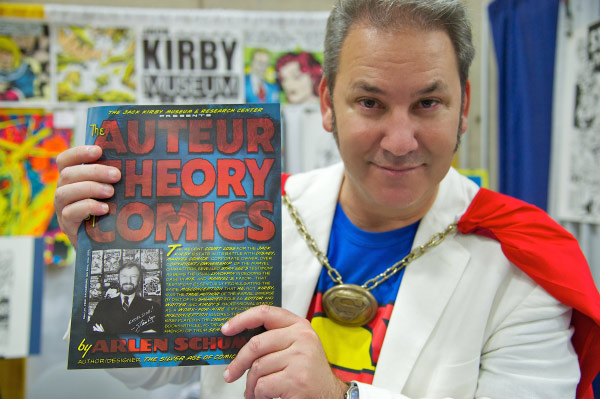
Comic-books historian and man with a taste for flamboyant outfits Arlen Schumer has a full lecture on this lesser known artist, who helped shape so much of the DC graphic identity over the years.


Likewise, calligraph extraordinaire Todd Klein dedicated quite a few posts to him on his blog. It' all worth reading.

Comics are a visual medium. On the top of my head I can only think to advertisement as the only other discipline that worked that extensively on the cusp where words become VISUAL OBJECTS, with meaning emanating not only from the IDEA sealed in the word, but from its visual presentation.

But advertisement is not an art (a pretty big statement I do not want to unpack here, even though I anticipate some antagonism to it), while comics is (note the singular).


Friday, 26 March 2010

Il messia alieno del pianeta K


Gli abitanti del pianeta K sono sull'orlo dell'auto-estinzione.
A nulla sono serviti i tardi tentativi di contenere il devastante effetto dei disastri ambientali prodotti dallo sfruttamento del pianeta.
Senza un futuro da lasciare ai propri eredi, un'elite di scienziati ha deciso di lanciare negli spazi profondi il loro bene più grande: i propri figli, nella speranza che possano trovare una nuova possibilità.

Cal-L, ancora in fasce, giunge sulla terra a bordo del proprio guscio spaziale.
Viene rinvenuto nelle campagne romagnole da Gianni Chendi e sua moglie Marta, semplici agricoltori avanti negli anni e senza figli.

I due adottano il piccolo, battezzandolo Carlo.
Carlo cresce come tutti i ragazzini dell'ameno comune di provincia, ma con l'arrivo dell'adolescenza comincia a manifestare qualità particolari. Oltre a possedere un’acuta intelligenza, Carlo si rivela il miglior atleta della scuola. Non solo: esce indenne dalle zuffe con ragazzi più grandi di lui ed un giorno si accorge che può persino compiere salti di grande altezza e gittata.

Quando Gianni e Marta decidono di rivelargli il segreto del suo arrivo, il giovane resta interdetto. Alla ricerca della propria identità decide di lasciare la casa dei genitori.

Torna dopo alcuni anni, oramai adulto. I suoi poteri hanno raggiunto proporzioni straordinarie. Ma Carlo è incapace di ignorare la chiamata alle responsabilità, che simili abilità comportano.

La passione per la verità lo porta a studiare giornalismo, spera di diventare un cronista. Il super-udito, la vista a Raggi-X e la capacità di volare possono dargli un notevole vantaggio nella caccia agli scoop (anche se Carlo avverte il dilemma etico di raccogliere notizie attraverso i suoi poteri).

Dopo la laurea viene assunto da uno dei più rispettati giornali del Paese.

Ma questo non basta. Un giorno, di fronte a un caso di violenza che sta compiendosi di fronte ai suoi occhi Carlo decide di intervenire in prima persona e salva alcune persone da un'aggressione.
Carlo si trasforma in un supereroe.
Da principio i resoconti su questo super-uomo volante suscitano ilarità o incredulità ma quando cominciano a essere sempre più numerosi il caso scoppia.
Si tratta di un vigilante solo, o di più persone? E se fosse una montatura? Vola davvero un eroe da fumetto nei cieli d'Italia?
Quando poi sono trafficanti, truffatori o addirittura latitanti ad incappare in questo "superman" il panico di una delle peggiori classi dirigenti mai viste sale a dismisura.

I politici si schierano unanimemente contro questo "attentatore alle libertà" questo "vigilante mascherato" anche se, come fanno notare alcuni commentatori, finora ha aiutato la cattura di colpevoli provati o colti in flagrante.

Carlo intanto comprende che i suoi scoop sono sempre meno graditi al suo editore, Alessandro Luttoni. Luttoni è presidente di un impero che comprende, oltre al quotidiano dove lavora Carlo, anche radio, canali televisivi, assicurazioni, immobili e molto altro. Non volendo mettere il proprio direttore in difficoltà nei confronti del proprietario (e seccato dai titoli a sproposito spesso scelti per contenere la portata esplosiva dei suoi scoop) Carlo decide di lasciare il prestigioso quotidiano.

Passa ad un piccolo giornale indipendente, dove il direttore Antonio Parri-Bianchi lo accoglie a braccia aperte garantendogli piena libertà di azione.

Le continue catture di Superman portano alla luce il verminaio della corruzione nella politica italiana. Le indagini e una risvegliata opinione pubblica fanno capitolare numerosi uomini di potere.

La desolazione politica però crea lo spazio per un nuovo "uomo della provvidenza": Alessandro Luttoni. Cavalcando la popolarità di Superman, l'imprenditore decide di appoggiarlo apertamente, e si candida alle successive elezioni presentandosi come la controparte politica del "nuovo eroe italiano".

Inutile dire che il tycoon non ha affatto intenzione di migliorare il Paese ma punta solo a difendere i propri interessi. Carlo questo lo sa: Luttoni ha più di un debito con la classe politica appena sgretolatasi.

Ma l'ascesa di Luttoni è inarrestabile: diventa primo ministro (e il nemico numero uno di Superman).
Carlo lo osteggia con tutte le proprie forze, anche se è difficile per un eroe onesto e specchiato avere la meglio contro un baro senza scrupoli.
Ma Carlo apprende presto che non saranno i suoi superpoteri la vera arma contro Luttoni, bensì la penna. (continua)

Friday, 26 September 2008

Secondo capitolo della mia personale guida al meglio del web-per-chi-ha-tempo-da-perdere.
Come accennavo in un post precedente, ciò che genera nausa nel Web è il rincorrersi di commenti, risposte e riciclaggi che proliferano con velocità virale.
Hai un'idea divertente? Il giornodopo è già presa, smontata, copiata, commentata, masticata e sputata.
Ci sarebbe da arrendersi.
Per questo sono rimasto sorpreso della piccola quantità di inchiostro versata riguardo Michael Argusso, noto con il modesto nome di “ItsJustSomeRandomGuy” o ancora più semplicemente “Random Guy” (letteralmente: “Tizio qualunque” o meglio “un tizio a caso”) e dalla esigua serie di imitazioni-omaggi-riletture che il suo materiale ha avuto.

Si badi, non è passato inosservato: i suoi video sono stati cliccati MILIONI di volte, il suo canale vanta una alta posizione per numero di abbonati su Youtube dove, visto il numero di utenze, qualsiasi posizione a due cifre può considerarsi un successo.

Forse complice una sua certa ritrosia dell'autore a parlare di sè se non attraverso i suoi filmati, di lui non si trovano che poche notizie sparse.
Allora ne parlo io, convinto che il buon lavoro vada premiato.

Argusso ha cominciato da una parodia (sì, anche lui).
Prendendo spunto dalla celebre e riuscita campagna pubblicitaria Get A Mac della Apple, già soggetto di numerose riletture, il ventisettenne americano ha cominciato a inscenare piccoli sketch che vedono protagonisti diversi supereroi delle due maggiori concorrenti americane Marvel e DC.


L'approccio è lo-tech: Argusso non fa altro che tenere in mano di fronte alla camera del proprio computer alcuni pupazzetti dei suddetti eroi.
Non c'è l'ombra di animazione passo uno.
Siamo quasi dalle parti del fotoromanzo, per dare una vaga ilusione di movimento Argusso cambia la posizione dei personaggi da un'inquadratura all'altra.
Quello che manca in effetti speciali è però compensato dall'ottima capacità di Argusso nel creare le caratterizzazioni vocali dei personaggi (spesso basate sulle voci degli attori che hanno interpretato i vari ruoli negli ultimi anni) e dal suo frizzante senso of humor.
Quanto sia difficile scrivere buoni dialoghi comici a “botta e risposta” che siano spigliati oltre che effettivamente divertenti per contenuto e “delivery” fatevelo dire da chiunque lo fa di mestiere.

Nei primi video della serie Superman si vede costretto ad ammettere, di fronte ad un imbarazzato Spider-man, la supremazia strategica nel marketing da parte della rivale Marvel, soprattutto nella gestione delle cosiddette movie-franchise.
GLi spot della Apple sono copiati per struttura ed in effetti ciò che fa ridere è la applicabilità della stessa formula ad un contesto completamente diverso (lì i computer, qui i film di supereroi)
A poco a poco si è visto aumentare il numero dei personaggi, tutti rigorosamente presi dalle pagine a fumetti: Batman, I Fantastici 4 e via aumentando.
Ironizzando sia sul contenuto delle storie a fumetti deipersonaggi, sia sulle spasmodiche attese dei fan per il prossimo hit cinematografico Argusso è esploso in una serie di divertentissime battute che si sono presto trovate strette nella formula "Apple".


La scena si sposta in un bar: scopriamo così che i supereroi vivono in una specie di cartoonia sospesa tra il mondo reale e quello delle loro storie a fumetti. Le loro identità e i loro poteri sono quelli che conosciamo, così come il loro carattere e le loro vicende personali, ma anche per loro i film sono film.

In una specie di "dopo lavoro", i diversi eroi si incontrano, parlano dei loro problemi, dei film su di loro e degli attori scelti per impersonarli, hanno le loro frustrazioni e le loro presunzioni, si innamorano.
Nascono invidie sulla base del regista chiamato al dirigere la prossima pellicola o sul successo monetario dell'ultimo capitolo.
Una nota amara si aggiunge quando gli stessi eroi si rendono conto di essere inverosimili, o peggio irrilevanti, oppure di avere passati davvero tragici, in un gioco totalmente autoreferenziale e squisitqmente scoperto.

Nonostante l'autore abbia col tempo dato maggiore attenzione alla confezione dei suoi filmati, con l'aiuto di una paziente fidanzata che realizza prop o vestiti di scena, la tecnica è rimasta molto semplice. E ci va bene così, perchè la qualità della scrittura nel frattempo è rimasta costante, anzi è migliorata.

Dopo primi sketch autoconclusivi Argusso è passato a realizzare interi archi narrativi di sei-otto episodi senza mai perdere di vista gli ormai numerosissimi personaggi che popolano la serie e utilizzando alcuni spunti marginali, anche piccoli, come trampolino per storie o gag successive.


Non vi racconto cosa è accaduto finora, per non togliervi il piacere della visione, ma per stuzzicare la vostra curiosità vi dico solo che al momento la seconda serie è cominciata: L'Uomo-Ragno tenta di diventare il sidekick di Batman, il Green Goblin è sotto allucinogeni mentre i buoni sembrano essere diventati i cattivi...


Il successo di Argusso sulla rete ha portato gli organizzatori della New York Comic Con a dedicargli un piccolo panel durante la manifestazione e gli ha chiesto di realizzare alcuni spot destinati al web per promuovere l'evento (la Marvel che nel frattempo ha notato il giovane ha dato il permesso all'uso dei propri personaggi)

In effetti la domanda che nasce spontanea è: “quanto ci metteranno editori di fumetti o stazioni TV ad accorgersi del talento di questo ragazzo e a dargli qualche idea da sviluppare?”
Senz'altro ha dimostrato di saper scrivere dialoghi, di saper caratterizzare i personaggi, di conoscerne sia la psicologia che la mitologia e si saper creare un intreccio.
Resta da vedere se il ragazzo sia in grado di scrivere anche altri generi e altri personaggi oppure se, ma questo lo ritengo improbabile, non sia assolutamente disinteressato a possibili patti faustiani col mondo dello show business e che si “accontenti” di regalare divertimento gratis ad un fedele (e crescente) seguito.
Purtroppo la frequenza dei filmati non è altissima, ma può anche darsi che Argusso abbia di meglio da fare che giocare con i pupazzetti, o che qualcosa stia bollendo in pentola)...