Friday, 27 August 2021

One Lovely Drawing

I hope David Apatoff will excuse me for borrowing the title from one of his recurring series, but I wanted to share this.


This panel comes from The Name of the Game (this is the italian edition, called Le Regole del Gioco) one of Will Eisner's last graphic novels and, in my opinion, one of his most accomplished.

I used to be a Will Eisner enthusiast, as all lovers of comics should be at one point in their life.

I've always been aware of his place in the history of the medium: I was introduced to his works by anthologies or articles stressing the importance of his work, but more than the praise, what captured me was the appeal of his style in The Spirit: the noirish use of shadows, the weird angles, the use of depth and layers in a single panel...

The fact that he wrote, penciled and inked his own work, the fact that he started producing personal graphic novels at a relatively advanced age, his convinction about the artistic mertis of the form, all this made him a hero in my eyes.

Whenever I would have the chance, I'd introduce Eisner's comics to friends and aquitainces

I remember how my friend Taiyo and I both smiled knowingly when the character of Hogarth shows a Spirit comic to his alien friend in Brad Bird's The Iron Giant.

I even had a very brief email exhange with him once (he gave me very simple and sensible advice, which I should have taken).

With time though, my feelings towards both his work and his persona has become a little more complex.

I started noticing some flaws in his drawings, the writing would strike me as pedantic at times, I missed the more experimental stuff he used to do with The Spirit that he abandoned in his later work.

A bit of the childish admiration I had for him was eroded when I realized the Spirit stories, although fully under his control, were the product of a studio effort that counted other writers, pencilers, inkers, colorists and letterers (although I totally get why and besides, that was the common practice for all cartoonists working for daily newspapers).

I won't discuss here other more controversial aspects about Eisner (I will in a future post), but even after all this caveats, I must say that I still go back to his work every so often (and that I second the choice to name an important award after him).

His job was personal and littered with little gems like this one.


It's a simple drawing, a panel of little importance in the narrative (although it encapsulates a few of the themes of the graphic novel), but everying about it is appealing.

The two men nicely fill the panel, leaving the right amount of 'air' to accomodate the speech balloon.

The difference of physical stature is used effectively to stage the moment.

The style of their wardrobe quickly conveys both the characters' status and time-period

I love how stylized the Sydney's face is (he's the tall one on the left) providing a nice contrast with Conrad's exaggerated facial expression on the right.

All this in a minuscule, spontaneous drawing that probably did not take long to draw and that will be quickly glanced over in the time it takes to read the short dialogue.


Friday, 6 August 2021

Zibaldone - Part 8

Things I do for other people (but really, for myself as well)


Thursday, 10 June 2021

Friday, 28 May 2021

Zibaldone (Part 6)


It's nice to be working again on something, with two of my favourite collaborators, no less: Fulvio Vanacore and Don Vitalski.

If one of the fellows in the first picture looks familiar, that is absolutely intentional.

(I think I'll soon write a post about him)


In the mentime, professor Lasson is back, but he's not having fun apparenlty.


In this new adventure he already risked getting mauled by a wild animal, drowned in a river and impaled in a booby-trab

Tuesday, 25 May 2021

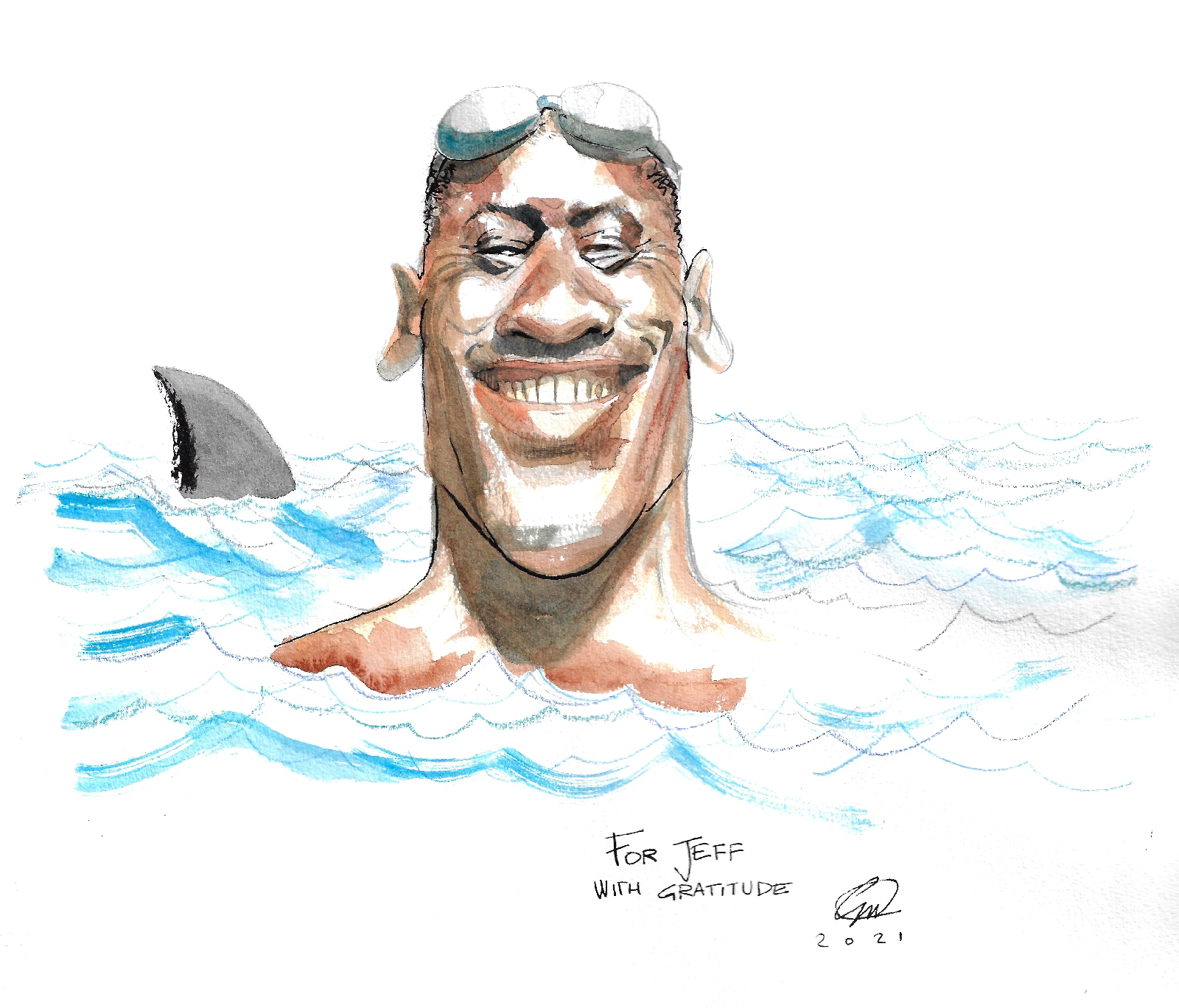
Jeff


Portrait of swimmer (and John Williams fan) Jeff Commings, with whom I've had the pleasure of hosting three episodes of The Baton podcast, available here:


I really look up to Jeff: besides being a professional athlete (which is already commenadble for the discipline and dedication required, let alone the stamina) and a teacher, he's incredibly polite, articulated, intelligent, brave and entreprising.

Recommended reading:


Friday, 21 May 2021

José Villarrubia: From a Colorist's Perspective


I know I just wrote only a few days ago that the less time we spend on social media, the better. I still stand by it, but I must also admit when people are using them right.

José Villarubia is one of those people.

My first encounter with this gentleman's work was on the pages of the ABC comic book line, written by Alan Moore (who else?).

He is an exeptionally talented artist, photographer and colorist and particularly in this last capacity he has made an incredible contribution to the field with his facebook posts about colors in comics.

I hope he'll manage to organize these into a lecture or an extensive article someday. For the time being, you can enjoy his insights via his Facebook photo album

From a Colorist's Perspective


In many of these posts he also tackles the issue of recoloring older comic books, which is a fascinating subject to me but also criminally neglected.

Well, ok, it's not a crime to ignore the subject, but how come there is a seizable awareness about the importance of preservation and presentation of film and music (with discussions about formats, supports, mastering techniques, accuracy) but almost none about comics?

¡Que viva José! then, who delivered possibly the first serious contribution to the field of comic book coloring studies.

Make sure you read his notes and all the comments, where the discussion gets juicy.


Thursday, 20 May 2021

Zibaldone (part 5)

Tuesday, 18 May 2021

Zibaldone (Part 4)

This is actually a published work.

Portrait of Jos De Saeger, flemish politician.


While this next piece is an attempt to portray Sandy De Crescent (of whom very few pictures are publicly available and none of them is recent).

If you know her name, it's because you are either a relative, or you are a professional musician working in Los Angeles, or because (like me) you are a soundtrack fan, of the kind that read all the credits in the album sleeve or in the end credits of movie.

Ms. De Crescent is best known as an orechestra contractor, meaning she is the one responsible of putting together a studio orchestra lmade of freelancers.

If you are interested in the subject, check out her interview at thelegacyofjohnwilliams.com


Monday, 17 May 2021

Zibaldone (part 3)

Today's piece is a portrait of conductor Brett Mitchell.

Brett currently serves music director of the Colorado Symphony, and his resume is pretty impressive.

What put him on my radar was a podcast about the music of Star Wars, I've written about here.

Maurizio, who is currenlty doing a splendid job at thelegacyofjohnwilliams.com, got in touch with him, so we decided to present him with this tittle loving tribute.

Here's a couople of lovely video's of Brett playing John Williams on the piano


Sunday, 16 May 2021

Zibaldone (Part 2)

"Zibaldone" is a term made famous by italian poet Giacomo Leopardi, who used it to name a collection of written notes, thoughts and reflections, kept for several years. It means "heap of things" and I like to use it as a placeholder for all my scribbles who I can't bother to better categorize.

The term was also used in the weekly (now monthly) sport magazine Guerin Sportivo for the 2-page spread dedicated to cartoons satyrizing the world of sports (it was the only section I used to read).

Thorugh the years I had different ideas about what this blog should be about, resisting the idea to turn it into a dump of personal art and thoughts because

1) I'm not particularly gifted as a writer,
2) nor as an artist;
3) I don't like vanity projects;
4) social media profiles seem better suited to that kind of simple 'content sharing'.

In a universe where I have little else to do, I'd love to produce longer pieces on topics that matter (at least to me) and leave a meaningful contribution, like i did here, here and here), but unforntunately I cannot afford that kind of time to spare.

But I don't want to discontinue this blog either, on the contrary : I'd like to revitalize it.

But lacking more substantial content, I think I'll go for the Zibaldone approach.

I do have heaps of pieces I wouldn't mind to share, and I'm not interested in using social media like Instagram or Facebook to do it  for a number of reasons among which:

1) The 'like' mechanism turns everything shared in a cry for attention while encouraging lazy interactions (rather than engage in commentary, people simply click on one option: Like, Love, Haha etc... also conforming to a very limited range of possible categories in reaction to something

2) Posting on social media platforms increase only the value of the company, but does not get me any piece of the pie. I suppose what I get in return are the services they offer, but although my personal contribution to the creation of value for Facebook or Instagram or whatever is of course absolutely marginal, still: I'm making money for them with my work.

3) Being active on social media is an invitation to other people to spend time there, which we all should do less.

ERGO

I'll just dump stuff here.
I hope you don't mind.

These are studies for a character in a story I'm currently working on. It's set in a Borneo-like environment, so I drew inspiration from this documentary:


and this is a piece of the final art


Monday, 12 April 2021

A note from 2019...

I recently happened to find a copy of the old Belgian magazine (A suivre) (which means "To be continued") laying around in a chalet we rented for a week end in the Ardennes.

Most of the material in it I knew: Schuiten & Peeters, Manara & Pratt, Tardi... all first rate creators.

I started to think about anthology titles from different countries, things like Eerie, Creepy, Mad, Tomorrow Stories (U.S.A.) Star Magazine, Hyperion, Comic Art, Linus, Horror, Frigidaire (Italy) Shoenen Jump (Japan), 2000 AD, Warrior (U.K.), not to mention that an awful lot of American comic book titles later known for showcasing one superhero, originally started as anthologies: Action Comics, Detective Comics, Amazing Adult Fantasy, Tales of Suspence...

The immediate feeling was one of longing: I missed the times when quality content could be showcased like hits on a radio station in an editorial format that allowed, from time to time, the introduction of new creators, stories, styles or characters alongside the more popular ones.

To me this is a formula that facilitates the grooming new talent.
Sprinkle a bit of editorial content in it (a letters column, an op ed piece, some reviews) and you can really 'build' an inforemd readership and even create a platform for the medium.

Yet anthology titles have mostly disappeared, together with newsstand distribution.

Why the lack of success?

Well, I suppose that we can partially ascribe it to the decline of printed media in general, but the majority of anthologies was discontinued long before that
One happy exception would be Walt Disney's italian weekly Topolino, still continuing an illustrious run, although it belongs to a category of its own and the circulation numbers of today, while still enviable, are but a portion of what they were thirty yearg ago.

However, I do not want to surrender to a pessimistic narrative, according to which things only get worse.

Yes, there are many things about the past I miss, but I'm afraid that my perspective is somewhat distorted, exactly because I keep using the wrong parameters to judge the current state of affairs.


Tuesday, 3 December 2019

Red Letter Mad

Quentin Tarantino's remarkable Once Upon a Time in Hollywood contains several nods to pieces of popular culture I hold dear: the lost art of movie posters, italian genre movies from the 70s, old western tv shows scored by people Jerry Goldsmith or Bernard Herrmann and, once again, comic books.

This time QT payed hommage to MAD Magazine, a seminal american publication influential to at least two generations of comedy writers, performers and of course cartoonists.

Watch Tarantino talking about it with late night show host Jimmy Kimmel (that part starts at the 6:35 mark):


For the movie, MAD veteran artist Tom Richmond created some wonderful illustrations.

This inspired me to create my little MAD Magazine homage, which is, at the same time, an hommage to Red Letter Media, a video/filmmaking company based in Milwakee, rised to Internet stardom in the last decade thanks to their witty, funny, insightful and irreverent video essays and review shows on YouTube.

I spend more time on YouTube than I care to admit, especially to have something to listen to whenever I do something which does not require much from the left side of my brain and for the last 10 years #RedLetterMedia put out consistently good content.

But more than that, their channel is essentially the YouTube version of a hang-out movie, as we feel like we got to know these people through their sarcastic yet laid-back attitude, their candor and the omnipresent corpsing and laughter.

Little did I know, while creating the piece, that DC Comics announced that it would cease the distribution of MAD Magazine in newsstands and grocery stores, marking the end of an era.


Friday, 14 June 2019

Ther Terminator vs. Ranxerox

In a recent conversation with czech comic book historian Pavel Korinek, we remarked how the field of comic book studies offers vast horizons for research; as opposed to other arts that have been endlessly analyzed and written over.

Up until now, comic book history and aesthetics have ben covered mostly by fans rather than academics (it's a gross over simplification, but it's true that the majority of in-depth books and articles about comic books have been written primarily by fans or insiders). 
And while fans and aficionados can be incredibly precise about certain details of their favorite subject matter, at the same time they do not apply rigorous standards when it comes to vet their sources.

The situation is anyway improving every year: there is more care, more substantial journalism, more academic research, and the possibility to cross-check information with a lot of ease thanks to the internet (although, the internet plays a major role in spreading inaccuracies as it does in divulgating knowledge).

One seminal publication for me was the italian Marvel anthology STAR MAGAZINE.
Alongside italian translations of Marvel Comics material, this magazine used to cover many aspects of the medium in reviews, retrospectives or interviews (and to the magazine's credit, not only focusing in about Marvel stuff).


Those columns were like a primer for my interest in comic book history.

However I had to recently think about one specific bit of information found in the article "Cinema & Comicworld" from STAR MAGAZINE issue 22, July 1992 (page 91):

"James Cameron openly stated to have modelled the features of his Terminator on Ranxerox, created by Stefano Tamburini and Tanino Liberatore"


The art in the article supports this connection.

Is this true? Did this underground italian comic serve as inspiration for the ultra-popular franchise?

In a video about the making of The Terminator James Cameron claims to have got the idea for his unstoppable robot killer from a dream he had while filming Piranha 2 around 1982, in Rome.
That would put Cameron in Italy right in the period when Ranxerox was being published.

If one considers that Mr. Cameron has been less than transparent about how much inspiration he drew from a couple of Harlan Ellison stories for instance, and if one compares the looks of two characters, the claims seems legit.
The resemblance is undeniably there, both in concept and appearance.


However, I have an hard time believing it.

First of all, I have never found any interview with Cameron confirming that. It looks like this notion is being passed among bloggers, columnists and artists, but is still unsourced. A quote attributed to Stefano Tamburini, creator of Ranxerox, also circulates in a similar unsourced fashion (supposedly the creator Stefano Tamburini lamented the lack of credit, saying that Cameron could have at least bought him a cup of coffie).

Secondly, it is also known that Cameron wrote the role of the Terminator for actor Lance Henriksen: in Cameron's initial pitch the robot was supposed to look like an nondescript, unimpressive human.
Casting Arnold in the role was happenstance: after becoming a star thanks to Conan the Barbarian, the Austrian bodybuilder had enough clout to demand and obtain the title role in the film, something the producers were happy to indulge, but with which Cameron had problems, as it would have completely blown his concept of an average-looking killer.
However, he went along and the rest is history.

But if that were the case, how does the Ranxerox connection fit the narrative?

Is the resemblance of the two characters just a coincidence?

This post doesn't close the case in any way. I think it would be fun to further research this connection, but if the burden of proof lies with the accuser, then Tamburini (who has passed away since 1986) should have brought more arguments and every other reporting the story should better check his or her sources.

Tuesday, 4 June 2019

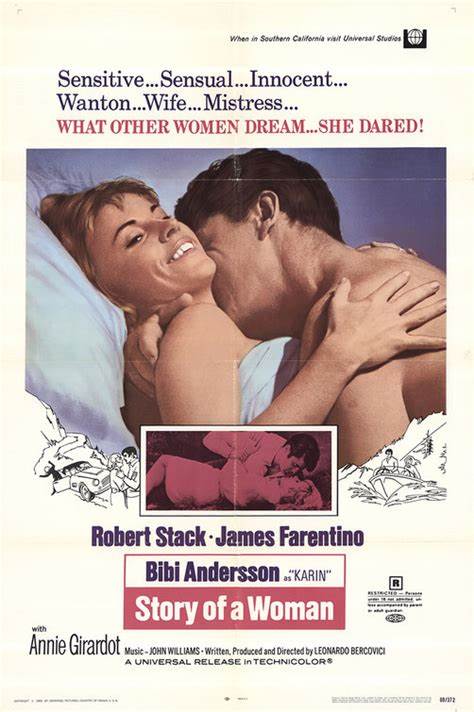
The Baton Podcast - Story of a Woman


By now the readers of this blog should have a sense of my love for John Williams' music. That is why I was thrilled when 


Jeff Commings of The Baton podcast asked me to co-host an episode of his show.

When Jeff embarked for the worthy endeavour of covering the entire filmography of composer John Williams one film at a time, I got in touch with him and immediately suggested that he reached out for co-hosts, since I believe that talk radio is at its best when there is some back and forth between people.

He took the advice, announced he would accept submissions and there you go, I was allowed to join the show in occasion of the "Story of a Woman" episode.


Being the film an obscure USA/Italy co-production and a prime example of BAD movie, it was an ideal fit for me (albeit the movie fails even at being entertainingly bad).

But the score is really worth a listen.

You can download the episode here

but I warmly suggest that you listen to the whole series.

Monday, 13 May 2019

More composers

Had some more fun with more portraits/caricatures of Hollywood composers.

Alfred Newman

Bernard Herrmann
Jerry Goldsmith


Thursday, 25 April 2019

Updates....


Some more recent art and sketches.

The first one is a promotional piece for Nerd Anti Zombie, the second novel by my dear friend Francesco Nucera.

The brief was to make an illustration that'll be printed on a t-shirt, featuring Bill Gates attacked by zombie Steve Jobs coming out of his grave.

My first sketches had a different layout

but upon seeng them, Francesco suggested to change the design in order to make it look like the cover of the first issue of Dylan Dog, an incredibly popular horror comic book in Italy.


This choice, perfectly understandable because it would add an additional intertextual reference and therefore reinforce the visual joke, posed a problem: having two real people in the picture required that I showed both faces, yet I needed Jobs to be the prominent zombie in the composition, if not the only one.
This meant I could not place him behind Bill Gates (it wouldn't be as menacing if relegated to the background) nor I could place him in front of him but also turned towards him.
I resolved that by making Jobs crawl out of his grave but unaware of the presence of his former Sylicon Valley competitor.
Bill Gates' pose, the tree and moon in the background are swiped in order to make the image a direct parody of the orignal. Hopefully Claudio Villa won't mind.


To complete the joke, I've colored the piece to replicate the original cover and added a logo in the same font.


And here you can see the finished product:


The following piece is a caricature of Italo Calvino

created as promotional art for an event.. I'm happy with the style, but I don't think I totally nailed the likeness...

I think I've done better with these other caricatures


Danny Elfman

Ennio Morricone

And since I really took a liking for caricatures people, I gave a shot to a couple of other movie-people

Steven Spielberg
Alexandre Desplat

These last two being only sketches at this point.

The following is my  most recent caricature, featuring composers/podcasters MArty and Will Brueggeman from the Underscore Podcast.


Monday, 8 April 2019

Will Eisner

Recently visited the Will Eisner exhibit at the BSC in Brussels.

My companion during the visit was the always nice Steven De Rie, who was warned by some fellow cartoonist not to expect much from the exhibition, since most of the samples  came from a single private collection.

I ignore what kind of show this other cartoonist expected, but the exhibit was really well done.
Sure there was a relatively little from The Spirit to see (only a handful of splash-pages) but the selections form the master's later works such as Dropsie Avenue, The Name of the Game or A Contract with God were substantial and diverse (not to mention practically the complete The Dreamer, a book that holds a very special place in my heart).

The pieces were accompanied by large panels of commentaries from the curators and some printed magazines froma all over the world.
If any criticism can be made about the exhibition is the scarcity of prep material such as sketches and/or scripts (it would have been interesting to see how the Spirit stories were plotted, scripted and then realized, especially beacuse the process involved other artists or writers).

Some more photographs may have helped too and it would have been great to have a screen or two playing excerpts from the various Eisner docs that DO exist.

Anyway, this should not be missed by any comic book lover who has the chance to visit Brussels or its surroundings.

The exhibition lasts until March the 2nd 2014. Entrance fee is 8 euros, but it buys the access to the whole museum (which is always worth the price)

PS: very very very nice chit-chat with Steven De Rie after the visit about all things comics. 


Prisoners of Gravity


In my book, one of the absolute highlights in television history has been Prisoners of Gravity.
Originally aired on TVO, the Ontario public service channel, the show delved in sci-fi, speculative fiction and horror genres in literature and comics (film was touched upon, but not extensively), long before "geek culure"* became cool.


The array of talent interviewed for the show is simply staggering: Jack Kirby, Will Eisner, Frank Miller, Alan Moore, Dave Gibbons, Neil Gaiman, Ray Bradbury, Peter Sraub, Harlan Ellison, Clive Barker, Terry Prachett, Doug Adams, Roger Zelazny, Samuel Delaney only to neme a few.

Those who would like te catch up with this well-aged piece of television can sink their teeth on this Youtube channel:

https://www.youtube.com/user/Teddog3000/videos

(a number of episodes used to be available at the TVO online archives, but once the agreements with the people interviewed expired had to be removed).

The host was comedian Rick Green, whe have since become one of my heroes for his work on AD(H)D.

Read here an interesting look back at the program by itys makers, appeared on WIRED.


* using this expression physically pains me.

Friday, 5 April 2019

Reflections: Growing Up With Music


A personal view about the music of John Williams and its role in my upbringing


This is a piece I wrote for the website thelegacyofjohnwilliams.com, curated by my brother Maurizio, who is doing  a remarkable job in "building a platform to celebrate and promote the cultural and aesthetic importance that the music of John Williams had (and it’s still having) on many people around the world".
I'm honored to having contributed the illustration for the header of the website, you can see here below.
Thanks to Maurizio for allowing me to me share my thoughts on his website.


As I am typing this, the sound of my son practicing scales on the piano resonates through the house.

I think back to my short-lived affair with the instrument.

I was about seven years old and I wanted to learn how to play piano from one of my older brothers, but he had just left to study in Rome. I was put under the tutelage of another teacher; whose lessons were tedious and devoid of the kind of fun I used to have around my brother. I quit after six months, a decision I still regret. But I wasn’t left without musical mentors.

Thinking of my older brother, a recent conversation we had springs to my mind about the different music teaching methods. He was telling me a funny anecdote involving an acquaintance of his, who wanted to educate his son outside of the western tonal system, to spare him from the conditioning imposed by our musical tradition, which puts certain intervallic relationships (like the tonic-dominant) above other possible modes. Ironically, this person’s efforts were made vain by the many nursery rhymes that the kid learned at school—nothing stick to our brains like simple, diatonic major melodies.

What’s the point of this story? Well not so much to discuss the pros and cons of equal temperament, but rather to point out how glad I am to be able to participate in the conversation. Because despite having given up on piano (or any other instrument for that matter) I’m not musically illiterate.

And for that I must thank John Williams.

Make no mistakes: I admit that the reason I gravitated towards Mr. Williams’ music were the movies he scored. Like many kids in the 1980s, I was utterly captivated by movies like Star Wars, Superman or E.T. They were perfectly executed pieces of fiction easy to fall in love with. Listening to those scores was a pathway to that sense of wonderment and excitement those movies provided.

But on repeated listening, the richness of these scores started to intrigue me. The dramatic drive of the pieces made the narrative clear, so I could tell at which point of the story I was listening to. The melodic writing made every moment memorable and singable. The rich instrumentation and length of the cues sustained my interest. So much that, as a teen ager, it took a long time to adjust my ears to the pop-music I was “supposed” to listen in the 1990s, to keep at pace with my schoolmates, who were into grunge, indie rock or Britpop.

But no matter how important John Williams music was to ignite my interest in music, you need teachers in flesh and blood to make the seed blossom.


Luckily, I had at least one: Umberto Bombardelli, a composer himself, who taught music at my middle school. He could have come right out of movies like Mr. Holland’s Opus or Goodbye, Mr. Chips—he even looked like Peter O’ Toole in that 1969 movie (with music adapted and conducted by John Williams, by the way).

At the time, music was a mandatory subject in Italy for students in middle school between the age of 11 and 14, but it was easily disregarded as an extra or a commodity, certainly not the subject that would make or break your graduation. However, Mr. Bombardelli taught passionately, with patience and humor, becoming soon known by his pupils as “the good teacher”.

He did a lot more than just make us play the recorder or put on Prokofiev’s Peter and the Wolf. He made us listen to various type of music (from Palestrina to Demetrio Stratos and Luciano Berio), teaching us about the different musical periods and styles. He even showed us movies and made us pay attention to the music (The Blues Brothers, Walt Disney’s Fantasia and also the Williams-scored The Cowboys). To this day, I owe him for laying the foundations of any musical knowledge I may have.

As I grew up, I gravitated towards Romantic or Post-Romantic composers, whose works shared a lot of common traits with the type of film music me and my brother Maurizio learned to love, from John Williams to Jerry Goldsmith, Alan Silvestri and Danny Elfman. The two pieces that encouraged me to explore the very rich catalog of classical music were the symphonic suite from George Gershwin’s Porgy and Bess (the great London Symphony Orchestra recording conducted by the late great André Previn) and Rimsky-Korsakov’s Scheherazade as recorded by Fritz Reiner with the Chicago Symphony Orchestra for RCA (this one kindly recommended by my brother Alessandro).

We used to have a public radio station that aired classical music nonstop 24/7 (the so-called filodiffusione, which is now part of the bouquet of radio channels managed by the Italian national broadcasting service, a.k.a. RAI) and I was listening to it at every possible moment—I once spent two hours pretending to pay attention during a class in high school while I was listening to Gustav Mahler’s Symphony No.3 through an earpiece hidden in my hand (true story).


From there it has been a fantastic voyage through multi-colored soundscapes. A journey I still enjoy every day. Today I do not have to rely on a fortuitous encounter with a dedicated teacher or on state-owned radio stations, the internet made it possible to discover and share gems very easily.

But it all started thanks to John Williams. And his music still works magnificently as gateway to musical appreciation.

In the meantime, the sound of scales has been swapped for more familiar tunes, as my son now plays the “Flying Theme” from E.T. and then “The Imperial March”, and then the Theme from Schindler’s List. I hear him stumble or hitting a wrong note here and there, but the pleasure he has in playing the music is palpable. Since I showed him Richard Donner’s Superman: The Movie, he became a big fan, so much so that he asked for the sheet music as present for Christmas. Even my wife, who does not care much about film music (but who has, unlike me, stuck to her piano lessons and CAN actually play the thing) is starting to warm up to Williams’s infectious tunes.

My mind wanders again: I now think of a painting one of my art teachers once did. It was called Music, a gift from heaven. It depicts a mandolin and a dove, against puffy clouds.

It was well drawn, but incredibly cheesy. But I do share the feeling.

And whether this gift comes from gods, from heaven or from nature, I will forever be grateful to Mr. Williams for delivering it to me.

---

The video here below, put together by composer Austin Wintory reflects many of the same feelings.